What are the advantages of a 13-pin towbar wiring kit over a 7-pin kit?
7-pin Connectors (ISO 1724)
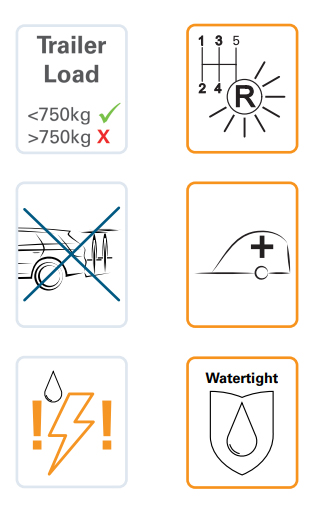
According to current regulations, trailers must replicate all lighting functions of the towing vehicle – only trailers of less than 750 kg are allowed to be operated without transferring the reversing light from towing vehicle to trailer. This means that trailers with more than 750 kg trailer load cannot legally be used with a 7-pin connector.
Using a 7-pin connector, it is only possible to supply the following lighting functions: two position lights, two turn signals, brake and fog lights. There is no pin left for the reversing light (mandatory for most trailer types as well as bicycle and luggage racks) or for auxiliary power sockets.
The housing of the 7-pin connectors is not watertight. If plug and socket are exposed to harsh weather conditions, the metal components (terminals, cables and spring) may start to corrode thus creating a risk of electrical damage to the system. The plug is fixed in the socket by extraction force only with no further fastening system.
13-pin Connectors (ISO 11446)
As towbar wiring kits with 13-pin connectors can transfer the signal for the reversing light (on pin no. 8), thus being able to replicate all of the towing vehicle‘s lighting functions, they are suitable for all types of goods trailers (light and heavy), caravans, bicycle carriers and luggage carriers.
With a 13-pin system, there are two pins dedicated for auxiliary power for a camper trailer: Pin 9 offers a steady power supply from car battery to trailer whereas pin 10 supplies power only when the ignition is switched on.
The 13-pin connector system is watertight according to protection class IP54. It is impervious to rain, tire splashes and pressure washing. The connection between the 13-pin plug and socket very reliable as it features a bayonet coupling which securely fixes the connectors.